


HRCap Partners with Dealsite Media to Host U.S. Localization and Compliance Workshop
From Hiring Compliance to Localization Strategy: HRCap Shares a Practical U.S. Operating Playbook for Korean Executives
Written by HRCap, Inc.
Published October 7, 2026

On September 30, 2026, HRCap CEO & President Stella H. Kim led the DealSite x HRCap Management Strategy Seminar: Practical Localization Workshop for K-Energy Companies Entering the United States, an interactive executive workshop designed to address rising workforce challenges through real-world hiring scenarios and localization strategies.
The seminar was particularly timely as Korean battery, clean energy, and technology companies continue to expand their investments and operations across the United States. Successful market entry increasingly requires more than capital, facilities, and local hiring; companies must also understand how U.S. employment practices, decision-making structures, and workforce expectations fundamentally differ from those in Korea.
Drawing from HRCap’s 26 years of cross-border HR experience, Stella focused on two areas that frequently create risk for Korean companies expanding into the United States: how organizations hire and how organizations localize.
When a Simple Interview Question Creates Compliance Risk
The first workshop focused on U.S. interview practices and the compliance risks that can arise when hiring processes developed in Korea are applied directly in the United States.
Questions intended as casual conversation around age, family, citizenship, salary history, or personal circumstances create legal and compliance exposure when unrelated to legitimate job requirements. The scale of employment-related risk remains significant. In FY2025, the U.S. Equal Employment Opportunity Commission received 88,201 new discrimination charges and secured almost $660 million in monetary relief for workers through enforcement and litigation.
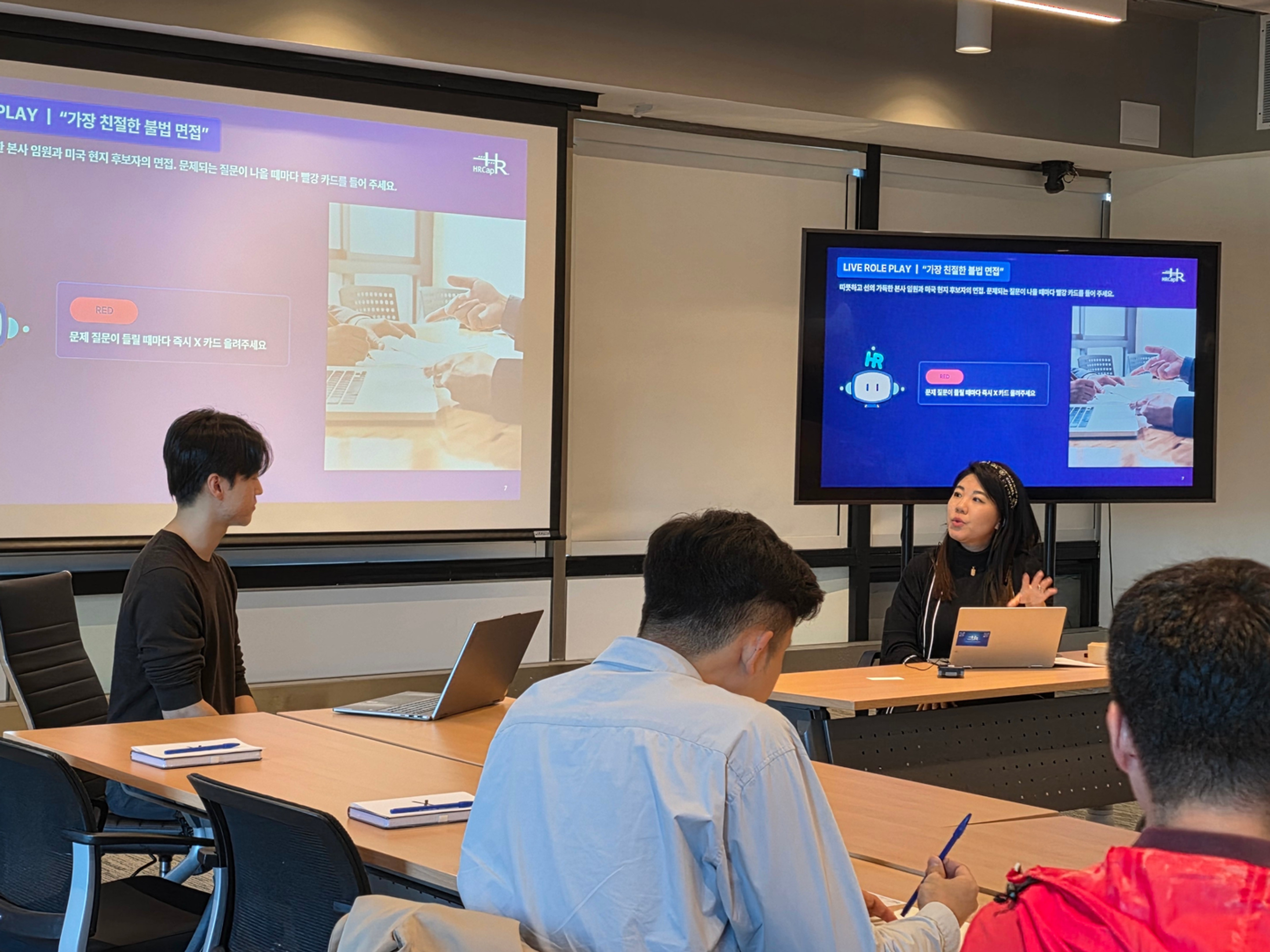
Rather than approaching compliance as a list of prohibited questions, HRCap emphasized the importance of building a structured interview process around job-related information and consistent evaluation criteria.
During an interactive role-play, attendees worked through common interview scenarios and discussed how questions can be reframed around legitimate business requirements. For example, hiring teams can focus on whether candidates are legally authorized to work in the United States and whether future sponsorship will be required, rather than seeking personal information unrelated to job performance.
Stella also highlighted practical steps companies can take to strengthen hiring consistency, including clearly defined job descriptions, advance resume review, aligned behavioral questions, and standardized evaluation scorecards.

The discussion further extended into how technology can support more structured and responsible recruiting. HRCap’s CAP AI™ Screening Solutions are designed to evaluate candidates against relevant job criteria while helping recruiting teams reduce repetitive screening work and maintain greater consistency throughout the assessment process. The platform also incorporates compliance and DEI guardrails designed to reduce reliance on protected or potentially bias-inducing information and promote more standardized, job-relevant candidate evaluation. The objective remains not to automate hiring judgment, but to help create stronger infrastructure around the decisions hiring teams make.
Why Localization Problems Become Operating Problems

The second workshop shifted from individual hiring decisions to the broader organizational structures behind successful U.S. expansion. One of HRCap’s central messages was that localization challenges are rarely caused by talent alone. They often emerge when the operating model itself has not evolved for the local market.
A U.S. subsidiary may have local employees and a local HR team while major hiring, compensation, budget, or operating decisions continue to require headquarters approval. In these situations, organizations can appear localized structurally without giving local leadership the authority required to operate effectively.
Over time, this can create what HRCap defines as Localization Debt — the accumulated operational friction that develops when local responsibilities expand faster than local decision-making authority, systems, and organizational infrastructure. To help organizations move beyond this pattern, Stella briefly introduced HRCap’s proprietary STAR Localization Model, which guides companies through four stages of localization: SHIFT, TRANSFORM, ALIGN, and RISE. The framework helps organizations clarify decision rights, build localized HR systems, align headquarters and local leadership, and ultimately develop a more self-sustaining U.S. operation.

[Read Related: HRCap Publishes 2026 U.S. Localization Book]
HRCap emphasized that localization therefore requires more than transferring administrative responsibilities, and companies must intentionally determine which decisions must be owned locally and which should remain with headquarters. As such, expatriate leaders can play a critical role in maintaining headquarters alignment and transferring institutional knowledge, while local leaders must also be given sufficient authority to respond to U.S. market realities, employees, customers, and operating conditions.
Building a Scalable Operating Model
Stella concluded the session by reminding executive leaders that investors and general contractors evaluate an organization’s actual operating model, including decision rights, safety records, and local staffing plans, rather than static organizational charts.
By aligning hiring practices with U.S. compliance standards and building structured operating frameworks, K-Energy enterprises and expanding corporations can successfully transition from initial setup to scalable, long-term growth.
Companies looking to elevate their U.S. market position, strengthen localization readiness, and build compliant HR infrastructure are encouraged to engage HRCap through our tailored Consulting Intelligence Solutions.
HRCap extends our sincere appreciation to DealSite Media for the partnership and for creating a meaningful platform to engage directly with Korean business leaders navigating U.S. expansion and localization. We value the opportunity to contribute practical workforce insights to this important conversation and look forward to continuing our collaboration.
Sources: HRCap, U.S. Equal Employment Opportunity Commission (EEOC)
========
Want marketing-leading updates on HR Trends, Recruiting Tips, and Career Advice?


